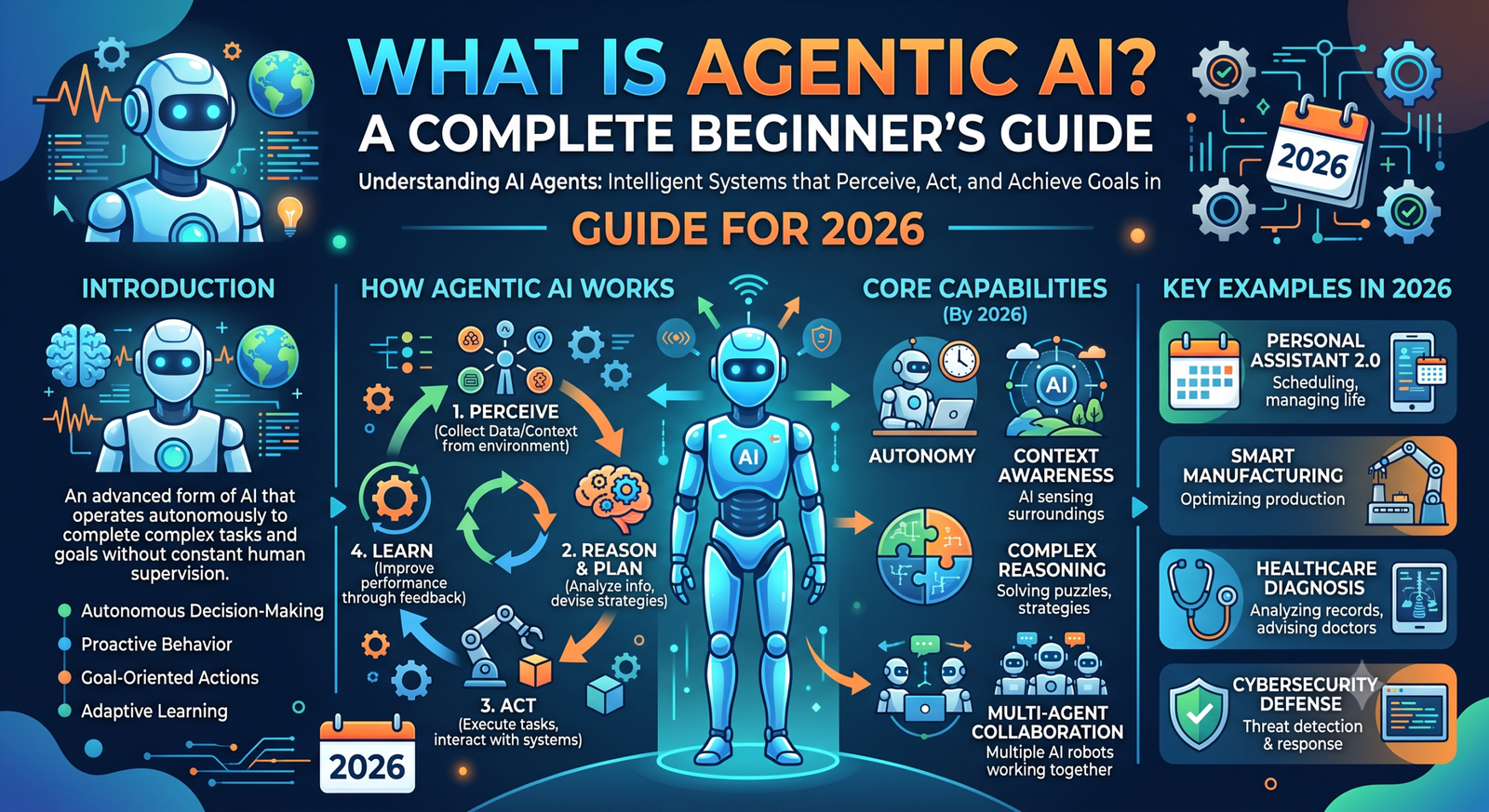
Artificial intelligence is moving beyond systems that simply answer questions. In 2026, one of the most discussed developments in AI is agentic AI—technology designed to pursue goals, plan multiple steps, use digital tools and take actions with limited human supervision.You may already be familiar with AI chatbots. You type a question, the AI generates an answer, and you decide what to do next. An AI agent takes a different approach. Instead of stopping at an answer, it can potentially determine the steps required to accomplish a task and use connected tools to carry them out.This shift is important because it changes the role of AI from a system that primarily responds to one that can act.But what exactly is agentic AI? How does it work? Is it the same as generative AI? What can AI agents actually do, and what risks should users understand?This beginner-friendly guide explains agentic AI in simple terms and explores why the technology is becoming increasingly important in 2026.
What Is Agentic AI?
Agentic AI is a type of artificial intelligence designed to pursue a goal by making decisions, planning actions and interacting with tools or systems with limited human intervention.Unlike a traditional chatbot that generally waits for each new instruction, an agentic system can break a larger objective into smaller tasks, decide what needs to happen next, evaluate results and continue working toward the goal.IBM describes agentic AI as an AI system capable of accomplishing a specific goal with limited supervision, while Google Cloud describes it as AI focused on autonomous decision-making and action.A simple example can make the difference clearer.Imagine asking an ordinary AI chatbot:“Find some good laptops for college students.”The chatbot may provide a list of recommended laptops.An agentic AI system could potentially take the request further by researching available options, comparing specifications against your requirements, organising the results and presenting a shortlist. If it has appropriate permissions and integrations, it could also interact with other software or services as part of the workflow.The important point is that agentic AI is about completing a goal, not merely generating a response.
What Is an AI Agent?
An AI agent is a software system capable of performing tasks on behalf of a person or another system.Modern AI agents commonly combine an AI model with tools, data sources, memory, instructions and mechanisms for taking action. Google describes AI agents as software systems that use AI to pursue goals and complete tasks, with capabilities such as reasoning, planning and memory.Think of an AI agent as a digital worker with a particular job.
For example, a customer-service agent might:
Read a customer's question.
Identify the problem.
Look up the customer's order.
Check relevant company policies.
Decide what response or action is appropriate.
Update the relevant system.
Respond to the customer.
The exact capabilities depend on the software, permissions and tools connected to the agent.
This distinction is important because AI agents are not magic autonomous employees. They operate within technical boundaries defined by their developers and the permissions they receive.
How Does Agentic AI Work?
Although implementations vary, an agentic AI system commonly involves several components working together.
1. Goal
Everything begins with an objective.For example:“Prepare a weekly sales report.”The system needs to understand what the user wants before determining how to accomplish it.
2. Reasoning and Planning
The AI determines what steps may be required.For a sales report, those steps might include:retrieving sales data,checking the reporting period,calculating totals,identifying unusual changes,creating charts,preparing a summary.Instead of requiring the user to provide every individual instruction, the agent can organise the workflow.
3. Tools
An agent becomes considerably more useful when it can interact with external tools.Depending on the system, these could include:databases,calendars,spreadsheets,search systems,business applications,code execution environments,document repositories,communication platforms.AI agents can use function calling and other integrations to interact with external systems rather than relying solely on information contained within the AI model.
4. Memory and Context
Some agentic systems maintain information about previous interactions or the current task.Memory can help an agent understand context without requiring the user to repeat everything.For example, a research agent might remember the research question, sources already reviewed and information still required.However, memory introduces its own privacy and security considerations. Organisations should carefully determine what information an agent is allowed to retain.
5. ActionThis is where agentic AI differs most noticeably from a basic conversational system.An agent can potentially perform an action after deciding what should happen next.That might mean updating a record, creating a document, searching a database or triggering another software process.
6. Evaluation and IterationSome agentic workflows evaluate the result of an action and determine whether another step is necessary.This can create a cycle:Understand → Plan → Act → Observe → Evaluate → Act againThe process can continue until the goal is completed, a defined limit is reached or human approval is required.
Agentic AI vs Generative AI
Agentic AI and generative AI are related, but they are not the same thing.Generative AI is primarily concerned with creating content such as:text,images,audio,video,computer code.
Agentic AI focuses more heavily on pursuing objectives through planning, decision-making and action.A generative AI system might write an email for you.An agentic system could potentially understand that an email needs to be sent, draft it, check relevant information, ask for approval and then send it through an authorised email system.The distinction is not absolute. Generative AI models can serve as the reasoning or language engine inside agentic systems.In simple terms:Generative AI creates. Agentic AI coordinates and acts.IBM similarly distinguishes agentic AI as the broader concept of solving goals with limited supervision, while AI agents are specific components that perceive information, make decisions and take actions.
Real-World Examples of Agentic AI
Agentic AI can potentially be applied across many industries.
EducationAn educational AI agent could help students organise study plans, identify topics that need revision and gather learning resources.For example, a student could provide an examination date and list of subjects. An appropriately designed system could create a study schedule and adjust it as progress changes.The goal should be to support learning, not simply complete assignments on behalf of students.
Customer Service
Customer-service agents can potentially handle multi-step requests.Instead of simply answering:“Your order is delayed,”an agent could potentially check the order status, review shipping information, determine whether company policy permits a particular solution and guide the customer through the next step.
Business AdministrationAdministrative work contains many repetitive processes that are suitable for automation.An agent could potentially:organise incoming requests,extract information from documents,prepare reports,schedule meetings,update records,route tasks to appropriate departments.The value comes from connecting several steps into one workflow.
Software DevelopmentAI agents are increasingly being explored for software-development tasks.An agent may be able to inspect a codebase, identify a problem, propose a solution, modify files, run tests and review the results.Human developers still need to verify important changes, especially where security, reliability or production systems are involved.
Research
Research-oriented agents can potentially search multiple information sources, compare findings, organise evidence and prepare structured summaries.Google Research described an agentic RAG approach in 2026 that uses iterative searching and multiple agents to break down complex enterprise queries and seek sufficient context before generating a response.
What Is the Future of Agentic AI in 2026?
Agentic AI is moving from an experimental concept toward practical business and consumer applications.
Google introduced new AI features in Search during 2026 that include agent-related capabilities, while Google Cloud has continued publishing guidance around building and deploying agentic systems.
At the same time, standards and security discussions are becoming increasingly important.
This suggests that the next stage of AI development will not simply be about making models generate better text or images. It will also involve making AI systems more useful, reliable, controllable and capable of working with other software.
The most important question may therefore change from:
“What can AI tell me?
”to:
“What useful task can AI safely accomplish for me?”
That is the central idea behind agentic AI.
Final Thoughts
Agentic AI represents an important change in the way we think about artificial intelligence.
Traditional software generally follows explicit instructions. Generative AI made it possible to communicate with computers using natural language and create useful content. Agentic AI takes another step by allowing AI systems to pursue objectives through planning, tool use, decision-making and action.
The technology is still developing, and not every system marketed as an “AI agent” offers the same level of autonomy or capability.
For users, the most sensible approach is to focus on practical value rather than hype. Start with well-defined tasks, limit permissions, monitor results and keep humans involved when decisions carry significant consequences.In 2026, the AI conversation is increasingly moving from generation to action.
Understanding agentic AI now can help students, professionals, educators and businesses make better decisions about where this technology can genuinely save time and where human judgement should remain firmly in control.